Author Archives: Chestnut Hill Nursery

Summer Watering Tips

As the days heat up, watering can become a dreaded garden chore and too many gardeners use wasteful techniques that use plenty of water but don’t give their plants the moisture they really need. Make watering plants easier and more efficient with the proper practices and tools…

  • Mulches not only make plantings look more attractive, but their most important functions are to help retain soil moisture and minimize weeds, which would also usurp moisture from your plants. Mulch around plants to a depth of 2-4 inches, refreshing mulch as needed to maintain that depth and attractiveness.
  • Watering cans and small containers work great for spot watering plants with different watering needs by hand. You don’t always need to get out a hose or sprinkler to get the watering done.
  • Check to make sure that you have the proper length hose(s) to reach every corner of your garden. Take into account any obstacles in the way, and be sure you aren’t dragging the hose over any delicate plantings to reach more distant dry spots.
  • Add a water wand to the hose to get the water where it’s most needed – the base of the plants – without needing to bend over repeatedly, which can cause back strain.
  • The best time to water is during the early morning hours of a sunny day. This will allow plants to absorb more water before it evaporates when temperatures rise, but won’t leave water to sit on plants overnight when mold can develop.
  • Always water plants and container gardens thoroughly and deeply to encourage deeper, more drought-tolerant root systems. It is better to water less frequently but more deeply rather than more often but with less water.
  • In the landscape, a good rule of thumb is to provide an inch of water per week minimum. Keep track of precipitation with a rain gauge to avoid wasting water by overwatering when Mother Nature does the job.
  • New individual plants that are set out, direct sown seed beds, sodding, etc. often require daily care, including watering, until established. Check moisture levels carefully during this period so the plants are well cared for.
  • Use soaker hoses to provide slow drip watering. This allows plants to absorb water easily without wasting water by evaporating from foliage or spraying into the air. Soaker hoses can even be layered beneath mulch to preserve as much moisture as possible.
  • Pay extra attention to plants in containers and hanging baskets as they tend to dry out faster and with greater frequency. These plantings will likely need to be watered daily or even multiple times a day during heat waves.
  • Place Tree Gators, a drip irrigation bag, on newly planted trees for slow, steady watering that will soak down to the root system without draining away along the surface of the soil.

If you’ll be away on an extended vacation, or even just for a few days, make arrangements with a trusted friend or neighbor to “plant sit” while you are gone. There’s nothing worse than worrying about your garden while you’re away – except coming home to crisp plants that haven’t been watered properly!

wisewatering1

wisewatering1

What to Do During a Drought

Dire warnings about drought conditions can worry even experienced gardeners, but there are easy ways to save water and save your trees, flowers, vegetable patches, herb gardens and decorative landscaping at the same time.

  • Spray Trees & Shrubs With an Anti-Transpirant
    If pruning, only remove dead material from trees and shrubs, anything more will encourage new growth. This takes energy that a drought-stressed plant cannot afford. Instead, spray leaves with an anti-transpirant or anti-dessicant to help leaves retain what moisture they have.
  • Water Early
    Morning temperatures are cooler and the sun is not as intense as later in the day so there is less moisture loss due to evaporation. Also, water sitting on foliage will have a chance to dry during the day minimizing the chance of fungal infection, especially during humid weather.
  • Water Slowly & Deeply
    Watering slowly will allow the moisture to penetrate more deeply into the root zone rather than running off the soil surface. Create depressions or water traps around larger plants to hold the water where you want it until it can saturate the soil. Remember to water trees at the drip line, not at the trunk base, as this is where the roots are most active. Drip irrigation bags are excellent for watering newly planted trees.
  • Thoughtfully Add to Landscaping
    If you are adding to your landscaping during a drought, choose water-wise, drought-resistant plants or consider xeriscaping techniques that minimize water use. Native plants, succulents and cacti are all great choices and require minimal water. In very severe drought conditions, it may be best to not replace plants, at least until watering conditions improve.
  • Water the Soil, Not the Leaves
    Plants take up water through their roots. Water landing on the foliage will be lost due to evaporation. The more water you direct to the soil, the less you will waste – drip systems and soaker hoses are ideal options. The key is infrequent but heavy watering rather than lighter, more frequent watering. This encourages deep root growth, which increases drought tolerance.
  • Conserve Precious Water
    Place a rain barrel under downspouts to collect rainwater. Wash the car on the lawn rather than on the driveway. Reuse “gray water” such as bathtub or dishwater and rinse cycle water from your laundry to water your garden. Collect the drip water from an air conditioner (may produce up to 5 gallons in 24 hours) for watering. Replace leaky hoses and sprinklers and use washers to correct leaks at fittings. Shorten showers, turn off the faucet when brushing your teeth and take other steps in the home to reduce water use so more is available for landscaping needs.

No matter how severe a drought or how low water supplies may be, there are ways you can deal with it and still keep your landscaping well cared for.

Drought_5Drought_1

Long-Blooming Perennials for Summer

By choosing long-blooming perennial plants, you can capitalize on the best of both worlds – plants that come back from growing season to growing season, and those that bloom for an extended length of time. This also means you’ll have more time to appreciate the gardens you create!

Here is just a sampling of long-blooming perennial plants perfect for the sunny summer garden:

  • Achillea (Yarrow) is a very drought and heat resistant plant once established. The flower heads are long-lasting and many colors are available including yellow, gold, pink and pastels in apricot, lilac, salmon, cream and white. Plants grow from 8-36″ tall, depending on variety. The flat-topped flower heads grow up to several inches across, and make excellent cut and dried flowers. The fern-like, gray to gray-green foliage is somewhat aromatic and attractive even when the plant is not in bloom.
  • Coreopsis (Tickseed) is one of the easiest and most rewarding garden flowers. The thread leaf varieties are usually the longest blooming, typically from June through fall. The pale yellow, bright yellow or rosy-pink daisy flowers smother the slender stems and thread-like leaves. Plant height, from 15-24″, is variety dependent. A mid-summer shearing of the seed heads will keep these plants blooming for many more weeks.
  • Echinacea purpurea (Purple Coneflower) is a sturdy, bold-textured favorite with dark foliage that grows to 2-3′ tall and wide. The flowers are large, daisy-like with unique standings of dark-rose purple and lighter in color. Birds and butterflies also love these flowers, adding even more beauty to your garden with their visits.
  • Rudbeckia (Black-Eyed Susan) is an old-fashioned garden favorite. It is hardy, reliable, insect and disease-free and an exceptionally long-blooming plant – typically from July through fall. This medium-green, bold-foliaged plant grows to about 3′ tall and bears golden yellow, daisy-like flowers with dark brown centers. Both Echinacea and Rudbeckia flowers make excellent cut flowers and a wonderful place for butterflies to sit and eat.
  • Gallardia (Blanket Flower) is an American native plant which thrives in the hot sun and has beautiful yellow-orange flowers, marked with red. Height varies according to variety. Some favorites include “Baby Cole” which is a dwarf only 8″ high, “Goblin,” a 12-15” grower, and “Burgundy,” which reaches 18-24” and whose flowers are a gorgeous shade of burgundy red.
  • Ceratostigma plumbaginoides (Plumbago) features intense blue flowers from mid-summer to September. Plumbago spreads quickly to form a neat groundcover and as an added bonus, leaves turn a brilliant red in the fall before dropping. This excellent perennial grows well in light shade also.
  • Veronica (Speedwell) has neat, attractive foliage and abundant flowers in densely packed spikes. Look for the cultivars ‘Goodness Grows’ and taller ‘Sunny Border Blue’ for a beautiful addition of blue to your summer garden, and pair it with red or white favorites for a patriotic theme.

Remember, this is just a brief glimpse of the long-blooming perennials available to choose from. Stop by to see our wide selection of perennials so we can help you determine which plants are best suited to your garden.

Long_3Long_4

Long_5

Long_1

Long_2

Grasses With Gusto

Ornamental Grasses lend a unique dimension to any landscape with their texture, sound, motion and architecture. By planting ornamental grasses, you can also add multi-seasonal excitement to your landscape. Either combined with other ornamental plants or featured by themselves in “Grass Gardens,” ornamental grasses are attractive from spring until late fall and often through winter as well.

Choosing Ornamental Grasses

It can be challenging to select the best ornamental grasses for your landscape. Choose from varieties that are short or tall, upright or weeping. Foliage can be bold or fine and comes in colors ranging from green, blue-green, lime-green, gold and red to variegated with horizontal or vertical bands of white or yellow. Flower heads can be showy plumes, fuzzy foxtails or airy particles and appear from mid-summer to fall, depending on variety. Dried flowers and leaves may persist into winter, looking particularly effective against a snowy backdrop.

Depending on the conditions of your landscape and your grass preferences, there are many different types of grasses to try.

Screens Or Barriers

Taller growing varieties such as Plume Grass (Erianthus ravennae) or Giant Miscanthus (Miscanthus floridulus) can be used as effective screens or windbreaks. The wind rushing through their foliage creates added sensations of sound and movement. Even some of the medium-sized growers, such as varieties of Miscanthus sinensis, can enclose a patio or act as a barrier against wind, noise or an undesirable view.

Specimens

Many ornamental grasses also make excellent specimen plants and can turn a dull corner into a focal point of color and texture. Some of the most dramatic grasses for specimen planting include Maiden Grass (Miscanthus sinensis gracillimus) with its graceful arching vase shaped foliage and pinkish blooms which age to cream, and Porcupine Grass (Miscanthus sinensis ‘Strictus’) that has upright green and yellow banded stems.

Waterscaping

Water gardens and ornamental grasses go together beautifully. A grouping of grasses looks particularly effective at the water’s edge, softening the boundary between land and water. Many grasses such as Miscanthus can tolerate moist conditions, some, like sweet flag (Acorus) and Giant Reed (Arundo donax), can grow in shallow water. Sedges (Carex), which are not true grasses, although similar in appearance, are also moisture-tolerant. Look for varieties with plain, variegated or golden foliage.

Groundcovers

Grasses that are groundcover varieties spread by underground stolons rather than forming tight clumps. One such selection is Ribbon Grass (Phalaris arundinacea ‘Picta’), a fast-spreading green-and-white variegated variety, particularly useful as a groundcover in difficult areas such as slopes or even under trees that cast light shade. Give this one plenty of space! You’ll also want to try green or variegated Liriope and Black Mondo Grass (Ophiopogon).

Beds and Borders

Massed in groups, ornamental grasses are wonderful as a background to, or in combination with, other plantings. Try planting them with perennials such as Black-eyed Susan, Sedum ‘Autumn Joy’ and Veronica ‘Goodness Grows’ or ‘Sunny Border Blue’ for a dynamic summer and fall interest addition to your landscape. Varieties for mass planting include Switch Grass (Panicum virgatum), whose upright delicate flowers are held above leaves that turn reddish in the fall; Korean Feather Reed Grass (Calamagrostis acutifolia ‘Stricta’) which yields stunning buff-colored plumes over a long period and Fountain Grass (Pennisetum alopecuroides) that sports maroon foxtails which age to cream in late fall. A number of different forms of Fountain Grass are available: ‘Hameln’ is a dwarf variety with creamy foxtails, while ‘Moudry’ has unusual black flowers. For edging beds and borders, plant low-growing Blue Fescue (Festuca glauca). Its steely blue clumps hold their color though winter and contrast well with pink or purple flowers or foliage.

Growing Grasses

Ornamental grasses are relatively easy to grow. A site that receives at least six hours of sun per day is best, although varieties such as Hair Grass (Deschampsia) and variegated Miscanthus (Miscanthus sinensis ‘Variegatus’) can grow well in as little as four hours of sun. Soil preparation, as with everything you plant, is a must, so work in plenty of organic matter such as peat moss, humus or compost. Fertilize in early spring with 5-10-5 or bone meal, when new growth is starting to show. Clumps should be cut back to within 6″ of the ground at this time, and can be divided if needed.

You’ll love the look ornamental grasses can give your landscape, and these easy-care plants can be effective at many functions in many different types of landscapes. Give them a try today!

Grasses_3Grasses_4

Grasses_1

green leaves of sedge cane

Clematis

Beautiful, showy clematis are not as difficult to grow as you might think. Learning when to prune your clematis and giving a little attention to their few requirements will reward you with a magnificent show of colorful blooms.

Planting Clematis

A beautiful clematis starts with proper planting. Clematis prefer to have their roots in the shade and their tops in the sun. Keep the roots cool with a well-drained rich soil with added compost, peat moss or composted manure and a good layer of mulch. Planting ground cover or other low growing perennials around the base of your clematis will also help to keep the soil cool and minimize weed growth. Organic amendments will help to retain moisture when added to the soil. Feed monthly with a liquid fertilizer or use a slow release fertilizer which can last for up to six months.

A Note About Bloom Rates

For the first few years, clematis may be slow to grow. Just keep in mind that it is establishing its root system, which is essential to a healthy, vibrant plant. In its first year, your clematis may produce very few flowers or even none at all. By the second year there will be more growth and a few flowers. By the third year you should see substantial growth and many lovely blooms.

Planting Clematis

For the best chance of success if you are new to gardening with clematis, buy plants in larger containers. While smaller starts will be less expensive to buy, they will take a little more work to establish and can be more delicate and prone to failure. If you purchase a pot of any size and are not planting it in the ground immediately, be sure not to allow the soil in the container to dry out or the plant may be overly stressed and vulnerable.

Keep the climbing habit of clematis in mind when selecting your planting site. Allow your plants to grow up into large shrubs and trees, or on a trellis against a sunny wall. Select varieties with growth that will not exceed your shrub or trellis; a 20-foot vine may overwhelm a smaller shrub or a weak trellis and will look overgrown and out of place.

Proper Pruning

Clematis are divided into three distinctive groups. Knowing what group your clematis falls under will guide you on when and how to prune.

These pruning suggestions are for established vines that have been in the ground for at least three years. Young vines should all be pruned to 12 inches the second spring and to 18 inches the third spring. This helps to develop more shoots, a fuller vine and a better root system.

  • Group 1
    This group includes certain species clematis and their cultivars which bloom early in the year. Some of the more familiar representatives of this group include the Montanas, varieties of C. alpina and C. macropetala. All of the Group 1 clematis bloom on growth made the previous year. They can be pruned to keep them within their allotted space or to remove dead and unsightly foliage. If they are pruned late in the season or before they flower, however, the cuts may remove potential flower buds and reduce that year’s flowering. To prevent this, prune Group 1 clematis right after flowering.
  • Group 2
    These are the large flowered hybrids. They are often divided again into two subgroups – 2a and 2b. All of the clematis in Group 2 bloom on ‘old wood’ (actually on short shoots from old wood) and should not be pruned except for deadwood pruning in early spring after the leaf buds open slightly.
  • Group 3
    These are the summer-blooming varieties such as the viticellas and Jackmanii types that bloom on new wood and the late bloomers such as Sweet Autumn Clematis (C. terniflora) and orientalis types. Clematis in Group 3 mainly flower on new wood produced in the current year and should be pruned back severely every year in late winter, when they are completely dormant, to about 12-14 inches. Leave at least two pairs of buds on each stem of the plant. Most clematis in this group are very fast growing and will reach their full height before blooming every summer.

Once you know how to properly care for clematis, you will find it to be a welcome addition to your landscape. If you aren’t sure just what your clematis needs to thrive, our expert staff will be glad to help be sure you and your plants have a great relationship!

clematis_1

clematis_2

clematis_3

clematis_4

Green Gardening

Planting a vegetable or flower garden seems like the perfect thing to do when you are looking for ways to adopt a greener, more environmentally-friendly lifestyle. Some traditional gardening practices, however, may not be quite as “green” as you might think. Planning your gardens with the environment in mind and choosing some practices that maintain healthy ecosystems can help you create a truly “green” garden. 

Tips for a Green Garden 

There are easy, effective steps you can take in your garden to go green, including… 

  • Plant local and native species of trees and shrubs which are naturally adapted to the conditions in your area, thus requiring less watering and having natural defenses for local insect pests and plant diseases.
  • Collect rainwater for watering your container gardens and new transplants, and adjust your irrigation schedule to compensate for whenever Mother Nature does the watering for you.
  • Use organic compost and mulch to improve soil health and reduce the need for pesticides and fertilizers. Better yet, make your own compost so you can adjust it to exactly what your plants need while keeping more waste out of landfills.
  • Opt for disease-resistant and pest-resistant plants rather than trying to force plants into an unfriendly area where they will need chemical assistance and extra maintenance to thrive.
  • Try to use natural products instead of chemical fertilizers and pesticides. Use traps, parasites and natural predators such as ladybugs and lacewings. Plants that repel insects – basil, chives, mint, marigolds or mums – mixed in with other plants can help keep pests away.
  • Choose wildlife-friendly plants such as flowerbeds that will attract hummingbirds, butterflies, bees and other pollinators, and don’t be upset to share some of your garden space with other critters.

These are just a few of the simple changes you can make in your gardening practices that will benefit the environment.

Green Products 

More and more “green” products are readily available to help you maintain the natural health of your garden. Before using a product, however, be sure it is suitable for your situation, and follow all application and use instructions. Even organic or eco-friendly products can become toxic contaminants if they are improperly used.

Popular options for green gardening products include… 

  • Dr. Earth contains probiotic beneficial soil microbes, plus ecto- and endo- mycorrhizae which feed the fiber of the living soil by releasing natural organic matter. People and pet safe.
  • Dr. Earth pest controls are organic controls for all of your pest problems, including all types of unwanted or troublesome insects. People and pet safe.
  • Espoma Organic Traditions line of products includes bone meal, kelp meal, garden sulphur, potash and garden lime for helping to improve your soil without artificial chemical compounds.
  • Bonide offers organic fertilizers as well as organic formulas for pest and plant disease control, such as fruit tree sprays.
  • Scotts Organic Choice lawn care products provide more environmentally friendly choices for your yard.

Developing “green” gardening practices benefits you and your family, your garden, your native plants and animals, your water supply – our world, all of us.

SONY DSC

Beetle Mania

It’s hard to forget the years that we’ve been plagued with Japanese beetles. These ravenous creatures can destroy your lawn, garden and good nature in one season by eating away precious time and money invested in our landscapes. As they know no boundaries, Japanese beetle control methods are most effective if neighborhoods band together in their efforts. So, rally the troops! 

Identification & Damage 

Japanese beetles are a problem at two stages of their life cycle: larvae and adult. The larvae, called grubs, are actively feeding from August through October and again in April through May. It is during this time that the grubs are closest to the soil surface feasting on plant roots, especially grass roots. A heavy grub population will result in dead patches of turf that can be lifted like a carpet. Japanese beetle grubs are 1 ½” long, C-shaped and white with a brown head. When gardening, you will almost always find some grubs in the soil. Small populations of grubs can be present in the soil without significant damage to the lawn. If you notice more than a dozen per square foot, however, this constitutes a problem that should be dealt with. 

Adult Japanese beetles have a hard-shell body that is about ½ inch long. They are metallic-green and copper-colored. At this stage, beetles can decimate a plant in record time by skeletonizing the leaves – nibbling off all the foliage between the veins. Adult beetles start to emerge from the soil with a frenzy of feeding, mating and laying eggs. You will find adults feeding in groups in full sun, and they feed on over 300 different species of plants. These insects maintain this frantic level of activity through the first half of August. The females lay their eggs on the ground. When the eggs hatch they dig their way into the soil to feast on plant roots in preparation for winter. As soil temperatures decrease the larvae move deeper into the soil only to resurface and feed on plant roots again in spring. 

Beetle Control Methods 

There are several methods to control both Japanese beetle grubs and adults, some environmentally-friendly and some more harshly chemical. Always read pest control labels in their entirety even if they are listed as organic or environmentally-friendly. These labels are meant for the protection of you, your plants and the planet. 

Environmentally-Friendly Adult Beetle Control 

Effective options for controlling adult Japanese beetles with the least harm to plants and the landscape include… 

  • Manual Removal – Pick off and destroy the feeding adults even if you see just a few. Japanese Beetles produce pheromones that will attract many more to your property, so it is best to pick them off and destroy them right away.
  • Use Non-Attractive Plants – If you have a shade garden you will not have a problem with Japanese Beetles. In sunny areas, choose plants that beetles don’t like.
  • Trap – Pheromone traps lure adult beetles, sometimes hundreds a day, and trap them in a disposable bag. Replace the bag as necessary. Place trap at least 20 feet from the plantings that you are trying to protect to lure the beetles away.
  • Row Covers – Floating row covers of reemay fabric may be placed over plants to avoid beetle damage by keeping the beetles from accessing the plants.
  • Pyrethrins – These insecticides are naturally derived from the pyrethrum daisies. Pyrethrins attack the insect’s central nervous system, producing a rapid knockdown. The residual effect, however, is only 5 days, so several applications may be needed to control severe infestations.
  • Insecticidal Soap – This soap is a contact kill with no residual control, but can be useful for smaller infestations or few beetles.
  • Neem Oil – This oil is an organic control that repels Japanese beetles. Spray early in morning or on an overcast day. Because neem is an oil, you may burn plant leaves if spraying in full sun. 

Chemical Adult Beetle Controls 

When using any chemical controls, read the product label completely and follow application instructions meticulously. It is a good idea to use a spreader sticker so that the chemical will adhere to the plant for the greatest effect. Popular chemical options to control adult Japanese beetles include… 

  • Sevin – This chemical is absorbed through the skin and will kill beetles on contact. It has a 7-10 day residual effect but must be reapplied after a rain. Consult label for recommended time that fruit and vegetables may be consumed after application.
  • Pyrethroides – Synthetic pyrethrin-like insecticides kill on contact and have an 8-10 day residual effect. Fruits and vegetables may be consumed in a shorter time period after application than Sevin.
  • Acephate – This systemic control works by poisoning the plant. The insect dies when the plant is ingested. Must not be used on edibles.
  • Malathion – This chemical must be ingested by the insect, however, this product may be used on edibles. Check label for number of days between last application and safe harvest.
  • Imidacloprid – Sold as a liquid form of Merit, this product is systemic and must be applied at least 20 days before anticipated adult Japanese beetle feeding. Only one application is needed per year. Use only on ornamentals.

Environmentally-Friendly Grub Control 

For truly effective Japanese beetle control, it is also necessary to control the grubs. This can be done in a number of environmentally-friendly ways, such as… 

  • Milky Spore – This biological control effects only Japanese Beetle grubs. Once this bacteria is established it can last in the soil for up to 20 years. It is completely harmless to people, pets, birds, fish and beneficial insects. Apply anytime the ground is not frozen.
  • Beneficial Nematodes – These microscopic worms kills grubs by feeding on, and reproducing in, the grub’s body. This is an excellent choice for a vegetable garden and should be applied after the soil is warm. Late summer/early fall application is best. 

Chemical Grub Control 

Chemical controls can also be effective at minimizing the harm from Japanese beetle grubs. Good options include… 

  • Merit – The granular form of this chemical is a systemic, season-long grub control with a 4-month residual effect, though it must be ingested by the insect. It is applied 3-4 weeks before grubs are actively feeding, mid-May through mid-June. Must be watered-in within 24 hours of application.
  • Dylox – This compound is absorbed through the grub’s ‘skin’ and will kill within 24 hours of application. Use only in late summer through early fall while grubs are still close to the soil surface. Must be watered in. It is active for up to 7 days in the soil.
  • Sevin – In its granular form, Sevin is a contact kill and will not remain active in the soil longer than 7 days. This product is used most effectively from mid-August through mid-October. Must be watered in.

With so many options for effectively controlling these pernicious insects, there is no reason why you need to keep being bothered by Japanese beetles. Once you know more about these insects and their habits, you can easily keep them away.

beetle-mania-2

beetle-mania-1

Protect Your Japanese Maples

Beautiful additions to any landscape, Japanese Maples will look their best when given some protection during hot, dry summers. As the weather becomes hotter and drier, your these trees may show signs of heat stress with the development of crispy leaf edges or, as conditions get even more extreme, leaf drop. This diminishes their stunning beauty and shrivels their leaves, but fortunately, there are several ways you can minimize this problem no matter what the weather. From planting these trees in the right spot to mulching the roots appropriately to using anti-transpirants, you can shield Japanese Maples from drought-like conditions.

Protective Planting

When planting a Japanese Maple, choose a location that receives morning sun only and has some protection from strong winds. Full afternoon sun and windy conditions will quickly stress plants and reduce leaf color. Planting a Japanese Maple in front of a western or southwestern windbreak of conifers or other evergreens will provide good shielding, or plant these trees on the eastern side of the house, garage or other structure to provide that essential barrier.

Save Moisture With Mulch

Mulching will help to retain moisture and cool root zones to protect these trees. Apply 2-4 inches of mulch under your Japanese Maples, extending out to the drip line for complete protection. Be sure to keep the mulch several inches away from the tree’s trunk to avoid fungus problems and crown rot. Ideally, install a drip watering system or other slow-release watering under the mulch to retain the most moisture with less water lost to evaporation.

Anti-Transpirant Sprays

Another way to keep your Japanese Maples looking their best is to use an anti-transpirant to helps minimize moisture loss from leaves. The best time to apply an anti-transpirant is in early summer when Japanese Maples are in peak condition, before they start showing signs of suffering from heat stress. Make your applications early in the day or on a cooler, overcast day to avoid leaf burn. Apply monthly through the hottest part of the year and your beautiful trees will look gorgeous heading into the fall season.

Japanese Maples are popular landscaping trees and make stunning specimen plants in any yard, but they can be subject to heat stress that will reduce their beauty and vitality. By taking several steps to protect them, however, you can enjoy the beauty of these trees even when summers are hot and dry, and properly protected, your Japanese Maple will look brilliant throughout the summer.

Yellowjackets: Good Guys or Bad?

When you hear “yellowjacket,” what’s the first thing that comes to mind? A buzzing, stinging insect ruining your outdoor meal or a treasured pollinator of many plants? A yellowjacket is both!

About Yellowjackets

The most commonly found yellowjacket is the Eastern yellowjacket (Vespula maculifrons). The Eastern yellowjacket is a wasp that is 1/2 to 5/8 inch long and is black and yellow striped. The body is curved under and is wider than the head. Yellowjackets do not have any “hairs” such as are found on honeybees and bumblebees.

Yellowjackets are generally ground nesters, however, in some situations, especially in urban areas, they will make their nest above ground such as in hollow walls and attics.

During the spring and summer, the colony population increases from the fertilized solitary queen, who survived the winter, to several thousand. Adult yellowjackets feed protein to the young wasps and larvae while they subsist on sugars. Foraging for food, the wasps cross-pollinate plants while seeking small insects and nectar. Yellowjackets provide a valuable service to humans by consuming numerous insects that eat ornamental and cultivated plants.

On the other hand, yellowjackets are drawn to cookouts, picnic areas and garbage cans. Their sting, unfortunately, is especially painful. Unlike honeybees, which only sting once, wasps can sting numerous times. Some people react severely to the venom and may have problems breathing or other dangerous reactions.

To Minimize Yellowjacket Interactions

Despite their good characteristics, many people prefer to keep yellowjackets away from picnics, play areas and yards. To reduce the possibility of inviting yellowjackets to your outdoor party…

  • Don’t leave moist pet food outside during the summer. Bird seed is fine, but not suet.
  • Keep garbage cans washed. Securely cover all garbage cans and recycling containers. Rinse beer, wine, soft drink and ice cream containers before disposing of them.
  • Keep garbage cans away from entertainment areas, play areas and pathways.
  • If eating outdoors, cover all serving plates and drinking glasses/bottles to prevent yellowjackets from getting into food or drink. When yellowjackets are in the area, be sure to check your food and drink before consuming.
  • Yellowjackets feed on aphids and scale on trees and shrubs. Therefore, spray for these pests in July and August, if needed, to remove that food source.
  • Repair dripping hoses and faucets as the puddles can attract wasps.
  • Wasps enjoy rotting fruit. Harvest tree and cane fruits when ripe. Carefully pick up all fallen fruit (gloves are a good idea!) and dispose of it in a covered container.
  • Wasps create a flight-path from the nest to food sources. Avoid this area. If this is not possible, consider removing the nest.

Yellowjacket Traps

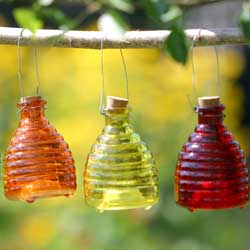
To help make your outdoor gatherings more pleasant and safer, yellowjacket traps can be effective. Hang these around the perimeter of your yard if you plan to eat outside, but never hang traps near the food area, as you will only increase the attraction to that area. Some traps are disposable and have the benefit of reducing the sting possibility. Others are “reusable” and must be emptied and refilled with bait. These increase the probability of being stung but can be more affordable in the long term.

Eliminating Yellowjacket Nests

When absolutely necessary, the elimination of a yellowjacket nest should not be undertaken lightly. If it’s early in the season and the nest is visible, a forceful water blast will break it apart. To reduce the chances of being stung, do this during the day while the workers are not home. Wasps return to the colony as dusk. Sometimes the workers will begin rebuilding in the same place. Pesticide sprays can kill wasps, and after the nest is destroyed, spraying the area can discourage rebuilding. If it’s later in the season, the aerial nest may be too large to eliminate safely.

Underground nests are a much bigger challenge to destroy. Because the entrance may be at an angle to the nest, flooding seldom works. Never try to burn a yellowjacket ground nest by pouring kerosene or other flammable liquid into the entrance and lighting it. In addition to many stings, more serious injuries may occur. This also pollutes the soil and a fire can quickly get out of control. If the flight pattern to the entrance creates a serious hardship or is close to a building, it is best to consult with an expert for safe nest elimination.

If the yellowjackets have built their colonies within your house walls or attic, it may also be necessary to contact a professional. Note: if yellowjackets are nesting in your home, do not plug the entrance/exit hole or they may chew the rest of the way into your house! Our experts can offer a professional referral for local wasp removal services or search “Pest Control” for your city on the Internet or in the yellow pages.

Yellowjackets do have their uses, but if you have no use for these stinging insects, there are many ways to eliminate them safely. Using several techniques will be most effective and will minimize the risk of being troubled by wasps again.

wasp-3wasp-1

wasp-2

Get Your Mint On!

And, they’re off!

As the iconic Kentucky Derby approaches, there’s no better time to refresh your mint knowledge and prepare for a thirst-quenching round of flavorful mint juleps.

The Early Times Mint Julep Recipe

  • 2 cups sugar
  • 2 cups water
  • Sprigs of fresh mint (spearmint is the favorite)
  • Crushed ice
  • Early Times Kentucky Whisky

Make simple syrup by boiling sugar and water together for five minutes. Cool and place in a covered container with six or eight sprigs of fresh mint, then refrigerate overnight to allow the mint flavoring to infuse.

Make one julep at a time by filling a julep cup with crushed ice, adding one tablespoon mint syrup and two ounces of Early Times Kentucky Whisky. Stir rapidly with a spoon to frost the outside of the cup.

Garnish with a sprig of fresh mint.

(Recipe from www.kentuckyderby.com/party, with permission)

Growing Your Own Spearmint

Want to add a personal touch to your mint juleps – or any other mint recipes – by growing your own spearmint? Nothing could be easier. However, there is one word of warning – containment. Mints quickly become invasive when left to their own devices so it is imperative to plant mint in a container or an area from which it can’t escape. Growing mint indoors is the ideal solution and ensures it is easily at hand whenever you have a recipe that calls for mint’s refreshing taste.

Easily grown from seed scattered on a moist surface, mint also transplants easily from purchased pots or from a friend’s garden. It thrives in moist shady areas and grows to 3′ tall. A light application of compost or a well-balanced fertilizer improves the quality but be careful; too much adjustment can also affect the overall flavor of the mint.

Harvesting is also easy. Whenever you want to use your mint, just wait until after the dew dries then cut the plant 3″ from the ground. Preserve by drying, freezing or storing in salt, sugar syrup, alcohol or oil. This method allows the mint oil’s distinctive taste and aroma to infuse the medium for future use.

Aside from mint juleps, varieties of mints flavor a wide assortment of foods from salads to sauces and cookies to ice cream. In the upcoming hot months, put spearmint in your lemonade (or beverage of choice). Of course, fresh mint has the strongest taste, so just pluck some, put it in a glass, and pour in the lemonade for a cool delightful thirst quencher with a sprig of freshness infused in every taste.

mint-3mint-1mint-2